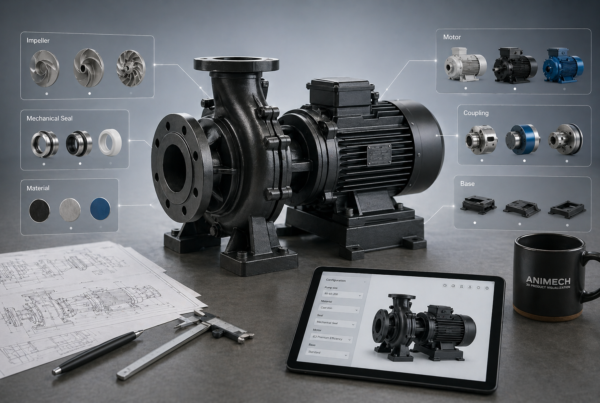
Complex products take time to buy. The buyer has to understand the options, check that the product fits, and often get agreement from others. A product configurator shortens that path in three ways: it educates the buyer, it builds confidence, and it removes the steps between choice and order. This applies to e-commerce and to B2B.
Three ways in short
- It educates the buyer. Every angle, option and dimension can be explored, even before the product exists.
- It builds confidence. The buyer sees exactly what they will get, so there is less reason to hesitate or ask others.
- It removes steps. The finished configuration flows into the cart, the quote or the order.
1. It educates the buyer
A large part of the sales cycle is spent finding out what the product can do and how it should be specified. In a configurator the buyer does that alone and at their own pace: turn the product, change options, see dimensions and what is included. Questions that would have gone to a seller are answered on screen.
2. It builds confidence
People hesitate when they are not sure the choice is right, and they ask colleagues, read reviews or wait. When the buyer sees and controls the exact product, much of that uncertainty goes. In B2B, a shared visual configuration also gives several decision makers the same picture. If you want the buyer to see the product in their own space, AR can be added.
3. It removes steps between choice and order
Without a configurator, a choice becomes an email, a spreadsheet, a quote and often a few corrections. With one, the finished configuration goes straight into the cart, or into a quote and an order, ideally connected to your CRM or ERP. The request reaches sales already specified. How integrations work.
How to see the effect
- Time from first visit or quote to order.
- Number of questions that reach sales before an order.
- Where users drop out of the configurator.
- Share of orders that need correction.
When it does not help
A product with few variants and a fixed price does not need a configurator. It pays off when complexity is real. See five reasons to use a 3D product configurator and how to buy.
Aniconfigurator is Animech’s 3D product configurator for complex products. See how Aniconfigurator works, or read about Visual CPQ, where a configuration becomes a quote.
Frequently asked questions
How does a configurator shorten the sales cycle?
It educates the buyer, builds confidence and removes the steps between choice and order, so fewer questions and handovers stand in the way.
Does this work in B2B as well as e-commerce?
Yes. In B2B the shared, visual configuration also helps when several people have to agree, and it can flow into a quote. See Visual CPQ.
How do we measure the effect?
Follow the time from first visit or quote to order, the number of questions that reach sales, and where users drop out of the configurator.
About the author. Staffan Hagberg is CMO and Head of Sales at Animech. He has sold real-time 3D and configurator solutions to industrial and consumer brands for about 14 years. About Animech.